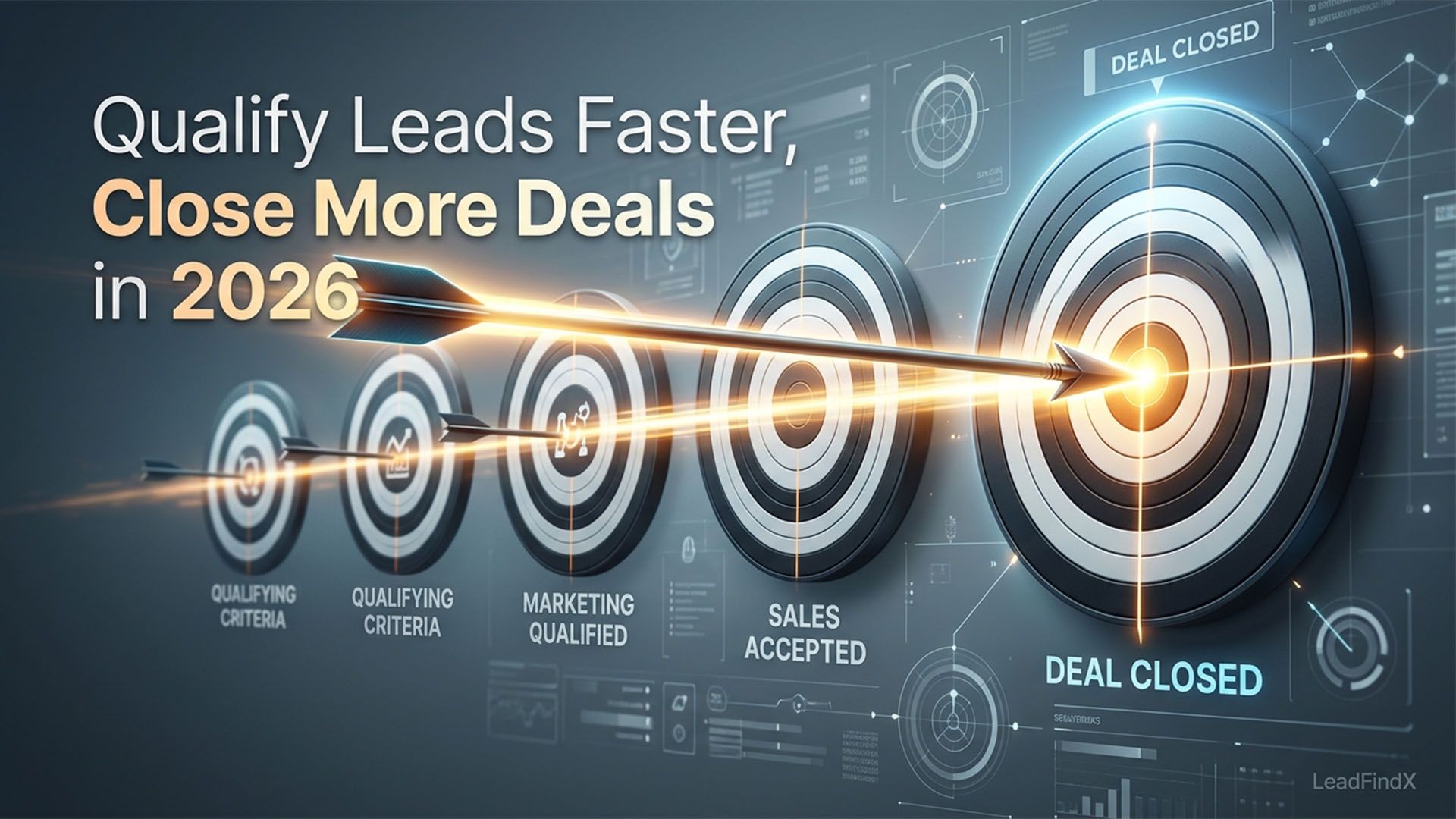
How to Qualify Leads Faster and Close More Deals in 2026
 LeadFindX
Qualifying leads is the difference between a bloated pipeline and a productive one. Learn the best lead qualification frameworks, questions, and tools that help sales teams filter faster, focus on the right opportunities, and close more deals in 2026.
How to Qualify Leads Faster and Close More Deals in 2026
A full pipeline feels good. A qualified pipeline closes deals. If your sales team is spending time on leads that never convert, the problem isn't your outreach — it's your lead qualification process.
This guide covers the best lead qualification frameworks, discovery questions, signals, and tools to help you filter faster, focus better, and close more.
What Is Lead Qualification?
Lead qualification is the process of evaluating whether a prospect is likely to become a customer — and whether it's worth your sales team's time to pursue them. Qualification filters out dead ends and focuses your resources on opportunities with the highest probability of closing.
A qualified lead (also called a Sales Qualified Lead or SQL) is someone who:
- Has a genuine need your product solves
- Has the authority (or access to authority) to make a purchase decision
- Has budget available for a solution like yours
- Has a timeline that aligns with your sales cycle
The Cost of Poor Lead Qualification
Poor qualification is expensive. Consider:
| Cost | Impact |
|---|---|
| AE time on unqualified deals | AEs spending 60% of time on opportunities that won't close |
| Inflated pipeline | False sense of pipeline health leads to missed forecasts |
| Lower close rates | Working unqualified deals drives down win rates and morale |
| Longer sales cycles | Unqualified leads drag on forever without closing |
Most sales teams that "need more leads" actually need better-qualified leads from their current lead volume.
The Top Lead Qualification Frameworks
BANT (Budget, Authority, Need, Timeline)
The original qualification framework, still widely used:
- Budget: Does the prospect have money allocated for a solution?
- Authority: Are you talking to the decision-maker?
- Need: Is there a genuine pain point your solution addresses?
- Timeline: When are they looking to make a decision or implement?
BANT works well for: SMB sales with short cycles and clear budgets.
Limitation: In modern enterprise sales, budget is rarely set before conversations happen, and authority is often distributed across multiple stakeholders.
MEDDIC / MEDDPICC
The gold standard for enterprise B2B sales qualification:
- Metrics: What quantifiable outcomes does the buyer want?
- Economic Buyer: Who controls the budget?
- Decision Criteria: What factors will drive the final decision?
- Decision Process: What steps will they go through to decide?
- Identify Pain: What's the specific, compelling business pain?
- Champion: Who inside the org is advocating for your solution?
- Competition: Who else are they considering?
MEDDPICC works well for: Complex enterprise deals with long cycles and multiple stakeholders.
CHAMP (Challenges, Authority, Money, Prioritization)
A modern alternative to BANT:
- Challenges: What business challenges are they trying to solve?
- Authority: Who makes the decision?
- Money: Is there budget or can it be created?
- Prioritization: Is this a priority initiative or a back-burner project?
CHAMP works well for: Mid-market deals where the conversation starts with challenges, not budget.
SPICED (Situation, Pain, Impact, Critical Event, Decision)
A customer-centric framework popular in SaaS:
- Situation: What's the prospect's current situation?
- Pain: What specific pain are they experiencing?
- Impact: What's the business impact of the pain?
- Critical Event: Is there a date or event creating urgency?
- Decision: What does the decision process look like?
SPICED works well for: SaaS sales with a product-led or value-first selling motion.
Lead Qualification Questions That Work
These discovery questions help qualify any prospect quickly:
Budget Questions:
- "Is there a budget allocated for solving [problem] this quarter/year?"
- "What does an investment of this size typically require in terms of approval?"
Authority Questions:
- "Who else would be involved in a decision like this?"
- "Who would need to sign off on moving forward?"
Need Questions:
- "What's driving the urgency to solve this now versus six months ago?"
- "What happens if you don't solve [problem] in the next six months?"
Timeline Questions:
- "When would you ideally want to have a solution in place?"
- "Is there a specific event or date this needs to align with?"
Disqualification Questions (equally important):
- "What would prevent this from moving forward?"
- "Have you tried solving this before? What happened?"
Lead Scoring: Automating Qualification at Scale
Lead scoring assigns numerical values to lead behaviors and attributes, creating an automatic qualification signal:
| Signal | Score |
|---|---|
| Visited pricing page | +20 |
| Watched demo | +15 |
| Opened 3+ emails | +10 |
| Downloaded content | +8 |
| Matches ICP (title, industry) | +25 |
| Company headcount in target range | +10 |
| Replied to outreach | +30 |
| Booked a call | +50 |
When a lead crosses a threshold (e.g., 80 points), they're automatically flagged as SQL and routed to sales.
The "Must Win" vs. "Nice to Win" Deal Segmentation
Not all SQLs are equal. Classify your qualified pipeline:
- Must Win: Strategic account, high ACV, champion engaged, timeline confirmed — assign senior AE
- High Priority: Strong fit, motivated buyer, realistic timeline — standard pursuit
- Low Priority: Soft interest, long timeline, weak champion — nurture only
- Disqualify: No budget, no authority, no urgency, no pain — remove from active pipeline
Qualifying Leads Inbound vs. Outbound
Inbound leads (who came to you) are generally better qualified than outbound leads (who you found). But "inbound" doesn't mean automatically qualified — many inbound leads are browsing, not buying. Apply the same qualification criteria to all leads regardless of source.
How LeadFindX Improves Lead Quality at the Top of the Funnel
The best way to spend less time qualifying leads is to start with better-quality leads at the top of the funnel. When your ICP targeting is precise and your contact data is verified, the leads entering your pipeline are already closer to qualified.
LeadFindX gives you precise ICP control from the start:
- Filter by industry: Only reach businesses in your target vertical
- Filter by location: Target specific cities, states, or countries
- Filter by keywords: Find businesses whose profile matches your ICP description
- Get decision-makers: Reach the buyer directly — not a gatekeeper who has to forward your message
When you reach the right person at the right company type with verified contact information, your lead qualification conversations are shorter and more productive — because the prospect already fits your ICP before you even dial.
Teams using LeadFindX report higher SQL rates from their outbound because the sourcing step is more precise than manual research or recycled database lists.
Frequently Asked Questions About Lead Qualification
Q: What is the best lead qualification framework for SaaS?
A: SPICED is the most popular framework for modern SaaS sales. It centers on the prospect's situation and pain, then builds to urgency and decision process. MEDDPICC is preferred for enterprise SaaS with complex buying committees.
Q: How do I qualify leads without wasting time?
A: Use a triage approach: first qualify on fit (company size, industry, job title), then qualify on timing (do they have an active initiative?), then qualify on authority (are you talking to a decision-maker?). Disqualify early if any of these are missing.
Q: What's the difference between MQL and SQL?
A: An MQL (Marketing Qualified Lead) has met the threshold for marketing engagement — they've shown enough interest to be worth contacting. An SQL (Sales Qualified Lead) has been vetted by sales and confirmed as a genuine opportunity worth pursuing.
Q: Should I disqualify leads or put them in a nurture sequence?
A: Disqualify leads with no budget, no authority, no need, or no realistic timeline. Put leads with good fit but wrong timing into a long-term nurture sequence — check back in 6 months or when their situation changes.
Q: How many qualifying questions should I ask in a discovery call?
A: Aim for 5–8 meaningful qualifying questions per discovery call. The goal is conversation, not interrogation. Mix in open-ended questions that let the prospect talk about their situation while naturally revealing qualification signals.
Conclusion: Quality Always Beats Quantity in the Pipeline
Filling your pipeline with leads that never close is worse than a small pipeline of genuinely qualified opportunities. The teams that hit quota consistently are those that qualify relentlessly — at the top of the funnel (ICP targeting), in discovery (qualifying questions), and throughout the sales cycle (ongoing re-qualification).
Start at the source. Use LeadFindX to build a prospect list that already matches your ICP — so you spend less time filtering and more time closing.