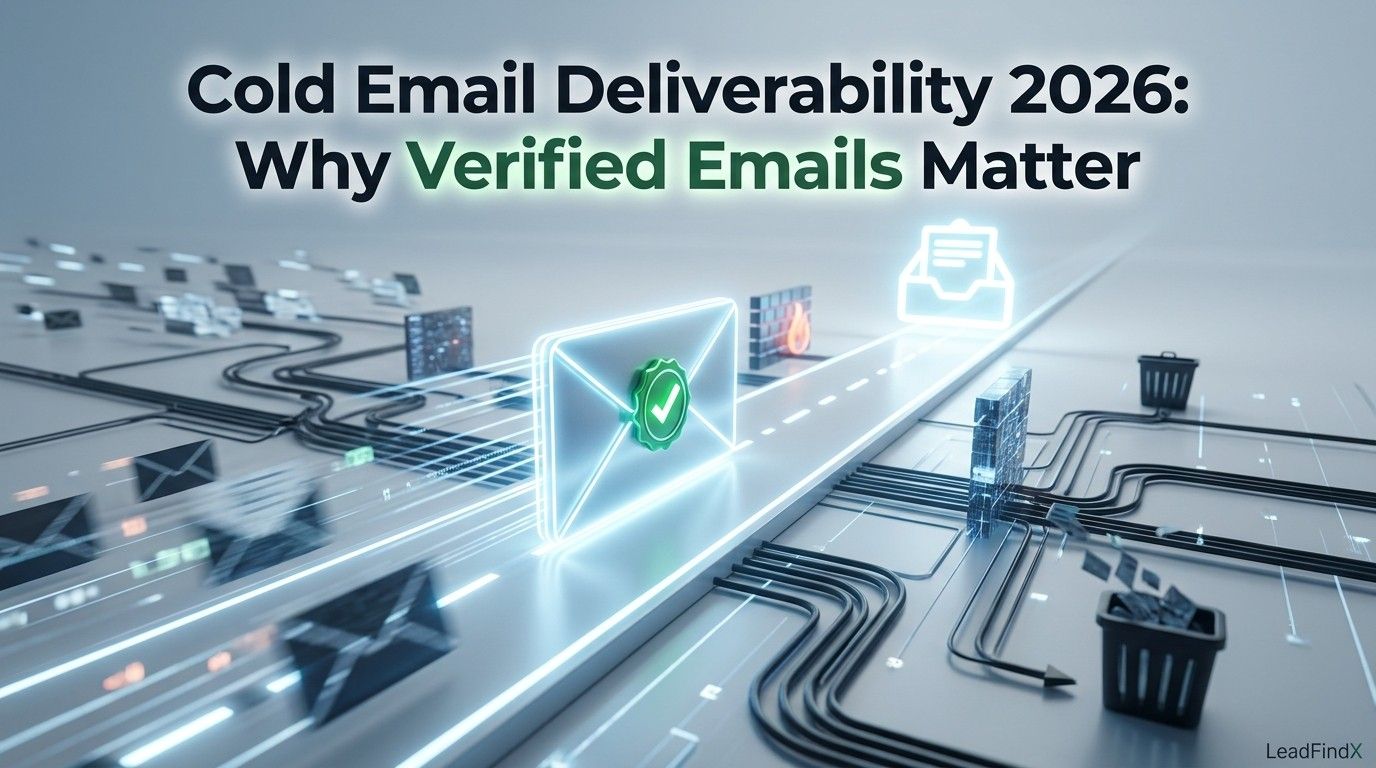
Cold Email Deliverability in 2026: Why Verified Email Addresses Are Non-Negotiable
 LeadFindX
Sending unverified cold emails is the fastest way to tank your domain reputation. In 2026, Google and Yahoo’s strict bounce rate thresholds mean that even a 3% bounce rate can land you in the spam folder permanently. This guide breaks down the critical difference between hard and soft bounces, the latest 2026 deliverability requirements, and how LeadFindX’s real-time verification ensures a 99% accuracy rate to keep your emails hitting the inbox.
Your Perfect Cold Email Just Hit the Spam Folder: Here’s Why
You've written the perfect cold email. The subject line is sharp. The personalization is real. The CTA is clear. You hit send on 500 emails.
And then... nothing. Not even bounces. You check Google Postmaster Tools. Your domain reputation is tanking. You're in spam. This is the most common cold email mistake, and it almost always traces back to one thing: unverified email addresses.
What Happens When Emails Bounce
Every email that bounces tells inbox providers (Gmail, Outlook, etc.) something negative about your sending behavior. A bounce rate above 3% is the threshold where serious problems begin. Above 5%, you risk your domain being flagged as a spam source—and once you're flagged, it takes weeks or months to recover.
The math is brutal: if you're buying a cheap email list with 80% accuracy, 20% of your sends bounce. On 500 emails, that's 100 bounces. You won't just miss those 100 prospects—you'll damage your ability to reach the other 400.
Hard Bounces vs. Soft Bounces
- Hard Bounces: (Address doesn't exist) These are the dangerous ones. They permanently damage your sender reputation.
- Soft Bounces: (Inbox full, server temporarily down) These are recoverable and expected at low rates.
Your goal is to eliminate hard bounces entirely—which means verifying every email before you send.
Why Verification Matters More in 2026
In 2024, Google and Yahoo both rolled out new sender requirements: proper SPF/DKIM/DMARC setup, one-click unsubscribe, and bounce rates below 0.3% for bulk senders. These requirements have effectively made unverified email sending a dead-end strategy.
Tools that verify in real-time—checking against live mail servers before confirming an address—have maintained inbox placement rates above 95%.
How LeadFindX Handles Verification
LeadFindX verify every email address in real time before a credit is charged. If we can't confirm the address exists and is live, you keep your credit. This is why our accuracy rate sits at 99%—we simply don't give you addresses we can't verify. That's our pay-per-verified promise.
The Full Deliverability Checklist
✅ Use a subdomain for cold email (outreach.yourcompany.com, not yourcompany.com). ✅ Set up SPF, DKIM, and DMARC properly. ✅ Warm up new sending domains for 2–4 weeks before bulk sends. ✅ Use only verified contact data—never unverified lists. ✅ Keep bounce rate below 2% (target below 0.5%). ✅ Include a one-click unsubscribe link. ✅ Send in batches of 50–100/day when starting out. ✅ Monitor Google Postmaster Tools weekly.
Your deliverability starts with your contact data
LeadFindX verifies every email before you spend a credit. 99% accuracy. No bounces. Get Verified Leads →