AI Lead Generation: How Artificial Intelligence Is Transforming B2B Sales in 2026
 LeadFindX
AI is fundamentally changing how sales teams find, qualify, and convert leads. This guide explores how AI lead generation works in 2026, which tools are actually delivering results, and how to integrate AI into your prospecting workflow for maximum pipeline impact.
AI Lead Generation: How Artificial Intelligence Is Transforming B2B Sales in 2026
AI lead generation is no longer a buzzword — it's the operational backbone of the fastest-growing sales teams in the world. In 2026, artificial intelligence is fundamentally changing how companies find prospects, qualify leads, personalize outreach, and forecast revenue
This guide breaks down exactly how AI-powered lead generation works, which capabilities actually matter, and how to integrate AI into your sales process for measurable results.
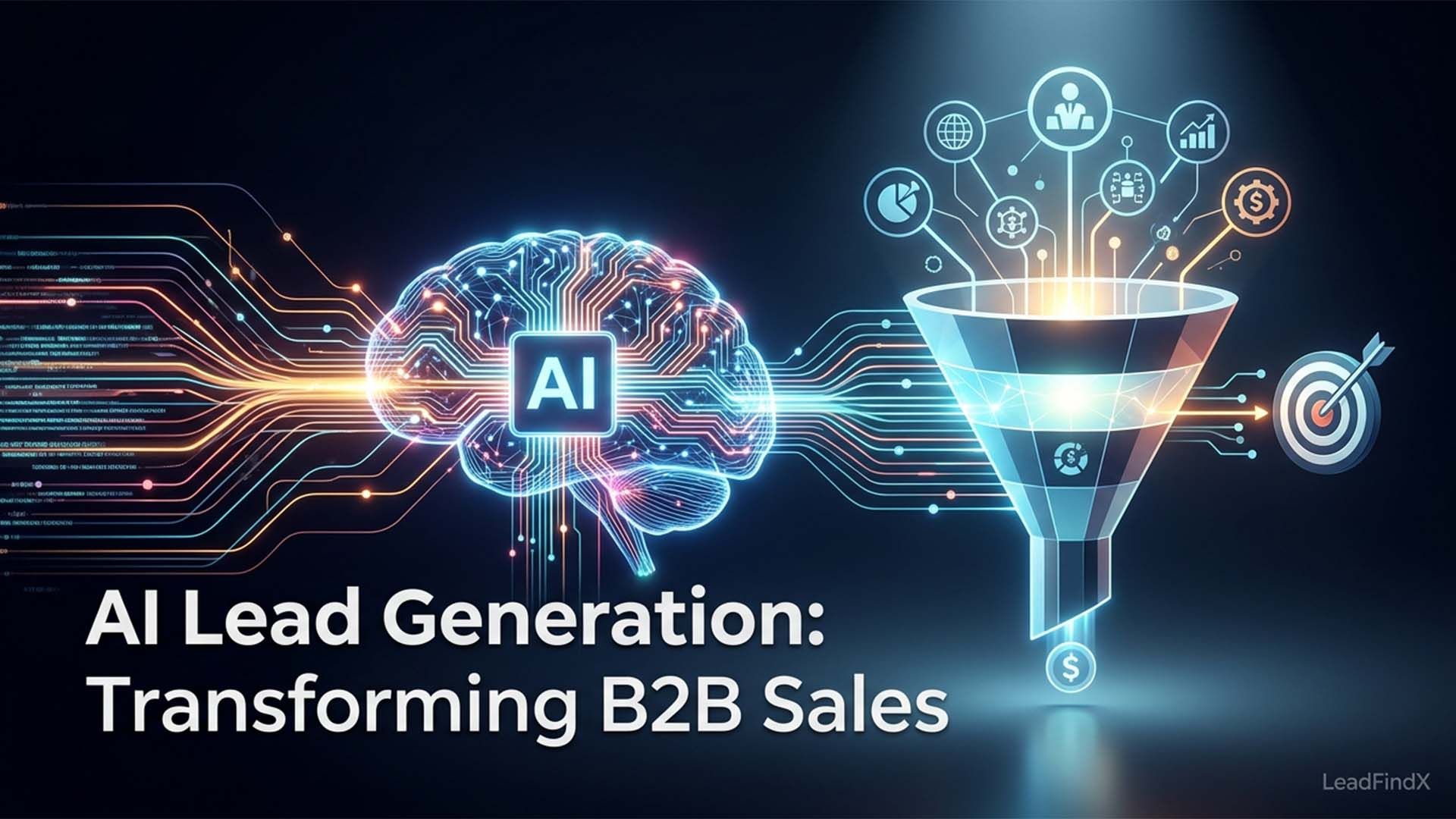
What Is AI Lead Generation?
AI lead generation refers to the use of machine learning, natural language processing, and predictive analytics to automate and improve the process of finding and converting prospects. It spans multiple stages of the sales funnel:
| Sales Stage | Traditional Method | AI-Powered Method |
|---|---|---|
| Prospecting | Manual research, database browsing | AI searches real-time data, surfaces ICP matches |
| Data Enrichment | Manual lookup across tools | AI auto-enriches contacts with email, phone, social |
| Lead Scoring | Manual or rules-based scoring | Predictive ML scoring based on behavioral + firmographic signals |
| Personalization | Manually researching each prospect | AI generates personalized snippets based on prospect data |
| Outreach Timing | Manual scheduling | AI optimizes send time per recipient |
| Pipeline Forecasting | Gut feel + spreadsheets | AI analyzes deal signals to predict close probability |
7 Ways AI Is Transforming Lead Generation in 2026
1. Real-Time Prospect Discovery
The most fundamental shift AI brings to lead generation is the ability to search and surface prospects from live data — not static databases that go stale. AI crawls business data sources in real time, matching businesses to your ICP criteria and surfacing fresh contacts instantly.
This eliminates the data decay problem that has plagued traditional database tools: AI-powered tools find current data rather than showing you who used to work at a company.
2. Automated Contact Verification
AI handles email and phone verification at scale — running SMTP checks, catch-all detection, MX record validation, and phone number verification in seconds. What used to require manual verification tools and hours of work now happens automatically, as part of every search.
3. Predictive Lead Scoring
Machine learning models trained on historical win/loss data can predict which leads are most likely to convert — before a human ever touches them. These models consider:
- Firmographic fit (company size, industry, tech stack)
- Behavioral signals (email opens, website visits, content downloads)
- Demographic fit (job title, seniority, tenure)
- Timing signals (recent funding, job posting, leadership change)
Teams using predictive lead scoring report 20–40% improvements in SQL rates and close rates.
4. AI-Powered Personalization at Scale
One of the biggest challenges in outbound is writing personalized opening lines for hundreds of prospects. AI tools now generate personalized first lines based on:
- LinkedIn activity and recent posts
- Company news and announcements
- Job postings that reveal company priorities
- Technology stack changes
This gives reps the feel of deeply personalized outreach at 10x the volume.
5. Conversational AI and Chatbots for Inbound Lead Capture
AI-powered chatbots (like Drift, Intercom, and HubSpot Chatflows) engage inbound visitors 24/7 — qualifying them with targeted questions, routing hot leads to sales reps, and nurturing cooler leads into email sequences.
In 2026, the best chatbots use large language models (LLMs) to have genuinely helpful conversations, significantly improving inbound lead conversion rates.
6. AI-Driven Email Deliverability
AI tools now optimize email deliverability by:
- Warming up new sending inboxes through AI-controlled send patterns
- Detecting and removing catch-all and high-risk addresses from lists
- Predicting optimal send times based on recipient behavior
- Rotating sending inboxes to avoid spam thresholds
7. Revenue Intelligence and Deal Forecasting
AI analyzes CRM data, email activity, call recordings, and deal history to predict:
- Which deals are likely to close and when
- Which deals are at risk
- What actions are most correlated with winning deals
- Where in the pipeline deals are getting stuck
Tools like Clari, Gong, and Chorus provide this intelligence layer on top of existing CRMs.
The AI Lead Generation Tech Stack in 2026
| Category | Function | Top Tools |
|---|---|---|
| AI Prospect Discovery | Find and verify leads in real time | LeadFindX |
| Predictive Scoring | Score leads by conversion probability | 6sense, MadKudu |
| AI Personalization | Generate personalized outreach copy | Lavender, Regie.ai |
| Email Sequencing | Automate multi-touch outreach | Instantly, Outreach |
| Conversation Intelligence | Analyze sales calls | Gong, Chorus |
| Revenue Forecasting | Predict pipeline and close rates | Clari, Aviso |
| Chatbot / Inbound AI | Engage and qualify inbound visitors | Drift, HubSpot AI |
What AI Cannot Replace in Lead Generation
Despite its power, AI has real limitations in sales:
- Relationship building: Human rapport, trust, and empathy remain irreplaceable
- Complex negotiation: Navigating enterprise deals with multiple stakeholders requires human judgment
- Creative problem solving: Understanding unique customer situations and tailoring solutions
- Ethical judgment: Knowing when not to pursue a lead or when a deal isn't right
The best AI lead generation strategies use AI to handle the repetitive, data-intensive parts of prospecting — freeing humans to focus on relationship-building and closing.
How AI Is Changing the SDR Role in 2026
The SDR role isn't disappearing — it's evolving. In 2026, the highest-performing SDRs use AI to:
- Research and source prospects 10x faster
- Personalize outreach at scale without compromising quality
- Focus their time on warm conversations and relationship development
- Let AI handle data hygiene, verification, and sequencing logistics
SDRs who embrace AI tools outperform those who don't by a growing margin. The future belongs to "AI-augmented" sellers, not AI-replaced ones.
The Ethics of AI in Lead Generation
As AI lead generation becomes more powerful, ethical considerations matter:
- Transparency: Don't impersonate humans in AI-generated outreach
- Data privacy: Ensure your AI tools comply with GDPR, CCPA, and relevant regulations
- Consent: Honor opt-out requests immediately, regardless of how contacts were sourced
- Accuracy: AI-generated content should still be reviewed for accuracy before sending
How LeadFindX Uses AI to Power Lead Generation
LeadFindX is built on an AI-first architecture for prospecting. Unlike traditional databases that collect static records, LeadFindX uses AI to:
AI-Powered Search: When you define your ICP (industry, location, business type, keywords), LeadFindX's AI engine searches live business data sources — not a pre-built database — to find matching businesses in real time.
AI-Driven Verification: Before surfacing any contact, the AI runs a multi-step verification pipeline: SMTP validation, catch-all detection, phone number verification, social profile matching, and website validation. You only see contacts that pass all checks.
AI-Refined Results: The AI filters out low-quality matches, ensuring the businesses surfaced genuinely match your criteria — not just keyword-matched but contextually matched.
Smart Exports: Export verified, enriched contacts directly to your CRM or sequencer in one click.
The result: verified, enriched, current leads delivered in seconds — the output that previously required hours of manual research across multiple tools.
Try LeadFindX free and experience AI-powered lead generation firsthand.
Frequently Asked Questions About AI Lead Generation
Q: Can AI fully automate lead generation?
A: AI can automate the research, discovery, verification, and initial outreach stages of lead generation with increasing effectiveness. The human touch remains essential for relationship building, complex discovery, and closing. The best approach is human + AI collaboration.
Q: Does AI lead generation comply with privacy laws?
A: It depends on the tool and jurisdiction. Reputable AI lead generation tools are designed with GDPR and CCPA compliance in mind. Always check a tool's data sourcing practices and ensure you include opt-out mechanisms in your outreach.
Q: How accurate is AI lead scoring?
A: AI lead scoring models built on sufficient historical data (typically 1,000+ closed deals) can achieve 75–85% accuracy in predicting which leads will convert. Early-stage companies without historical data need to rely more on rules-based scoring while building their dataset.
Q: What's the ROI of AI lead generation tools?
A: Teams using AI lead generation tools consistently report 30–60% reduction in research time, 15–30% improvement in email open and reply rates, and 20–40% increase in pipeline generated per rep. ROI varies by tool and implementation.
Q: Is AI-generated cold email effective?
A: AI-assisted personalization (using AI to research prospects and generate opening lines) is highly effective. Fully AI-generated emails sent without human review tend to lack the nuance that gets replies. The best approach is AI for research and personalization snippets + human for message structure and judgment.
Conclusion: Embrace AI or Fall Behind
AI lead generation is not a future trend — it's the current standard for competitive B2B sales teams. Teams that haven't integrated AI into their prospecting workflow are already at a disadvantage.
Start with the most impactful AI upgrade: verified prospect data. LeadFindX's AI-powered platform delivers fresh, verified B2B leads in seconds — try it free with 10 verified contacts, no credit card required.